Diaphragm Electrolyzer Technology

Diaphragm electrolysis is a proven and reliable technology for the production of chlorine gas and hydrogen from hydrochloric acid. Chlorine is generated at the anode, while hydrogen is produced at the cathode, making this solution ideal for plants that require hydrogen as a valuable by-product and do not rely on an oxygen feed.

The electrolyzer is based on a robust filter-press-type bipolar design using graphite electrodes separated by durable PVC or PVC/PVDF diaphragms. Engineered for operation under highly corrosive conditions, the technology offers high availability, long service life, and the flexibility to adapt to related production processes. Its maintenance-friendly design also enables straightforward capacity expansions.
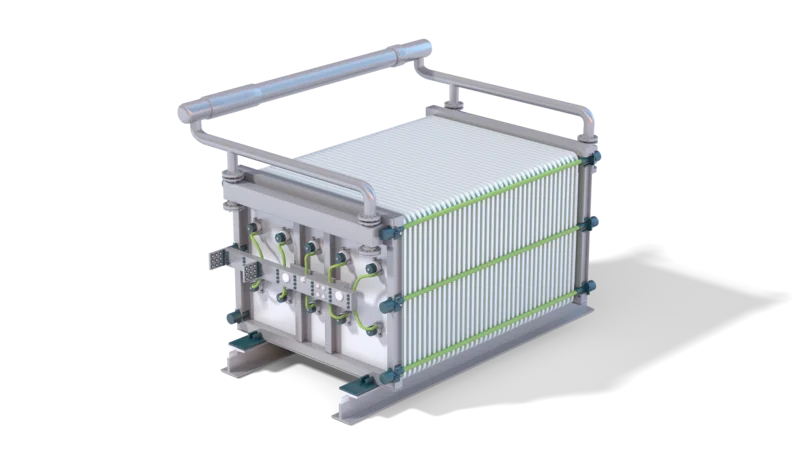
Key features of Diaphragm Electrolyzer Technology

  • Simultaneous production of chlorine and hydrogen
  • No oxygen supply required
  • High robustness and durability in corrosive conditions
  • Flexible operation and easy process integration
  • Maintenance-friendly design with expansion capability
  • Proven industrial technology ensuring high availability

Download Brochure

How does the Diaphragm process work?

HCl Absorption and Treatment

When integrated with MDI/TDI plants, the process starts with anhydrous hydrogen chloride gas, which is conditioned in an absorption unit. The absorption of HCl in water or dilute hydrochloric acid is strongly exothermic. Industrial applications typically require hydrochloric acid concentrations between 28 and 37 wt.%.

Electrolyzer with Anolyte and Catholyte Recycles

The concentrated aqueous hydrochloric acid is fed to both the anolyte and catholyte systems. Separate acid recycle loops are used for anolyte and catholyte, each operating at different concentrations: approximately 23 wt.% in the anode compartment and 21 wt.% in the cathode compartment.

Within the electrolyzer cell, chlorine and hydrogen are generated. Depleted hydrochloric acid with a concentration of approximately 17 wt.% exits both compartments. The anolyte flows through the anode chambers connected in parallel, while the catholyte flows through the cathode chambers in a similar configuration. Solid impurities are removed via filtration, and heat exchangers are used to maintain the thermal balance of the process.

A partial stream of the 17 wt.% hydrochloric acid is diverted from the catholyte recycle, reconcentrated with hydrogen chloride to approx. 28-37 wt.% in the absorption unit, and then returned to both electrolyte recycle loops.

Product Treatment

After cooling and filtration, the wet chlorine gas is either fed directly to downstream consumers or dried and compressed. The chlorine can then be routed back to the consumer to close the chlorine recycle loop or liquefied for storage in tanks.

Hydrogen is produced as a valuable by-product. Once cooled and scrubbed with caustic soda, it can be supplied to hydrogen consumers, such as hydrogenation plants.

Worldwide Service

We support you beyond technology delivery. Our services cover the entire lifecycle of your plant—from process design and commissioning to performance optimization and long-term operation. With deep application know-how and a strong focus on safety and reliability, we help keep your processes running efficiently.
Explore Service Solutions

an employee of thyssenkrupp nucera in front of an electrolyzer

Talk to Our Experts

Looking for a tailored solution or technical support? Our experts are ready to discuss your requirements and identify the best approach for your application. Get in touch with us to start the conversation.

Contact Us Now