From Energy Shocks to Energy Resilience: Why Europe Must Build Electrolysis at Scale
Our energy reality is changing – and so are our priorities. Europe’s structural energy dependence has become an economic, industrial and strategic risk. Geopolitics now shape decisions in boardrooms, across supply chains and in society. Yet, we keep repeating the same pattern: we move from one energy shock to the next. Each time, the reaction is immediate – urgent calls to act. Then the crisis fades, and the focus snaps back to short-term cost efficiency, without lasting lessons learned. That is not how you build a resilient energy and industrial system. Resilience is no longer a long-term ambition, it is a current necessity. But resilience cannot be built on imports alone. We must complement imports with domestic energy generation. By reducing dependency, we reduce the economic damage a crisis can inflict.
According to estimates by the German Economic Institute, the current Iran crisis alone could cost the German economy more than 40 billion euros by 2027. For Europe, the economic impact is likely to be 10 to 15 times higher. If we invested even a fraction of that amount into making our energy system more independent, we would be far better prepared for the next crisis. I want to offer the perspective of an electrolyzer manufacturer: our role, how we work with partners – and what it will take to unlock market scale-up.
WHS Rotterdam / Maarten Schuth
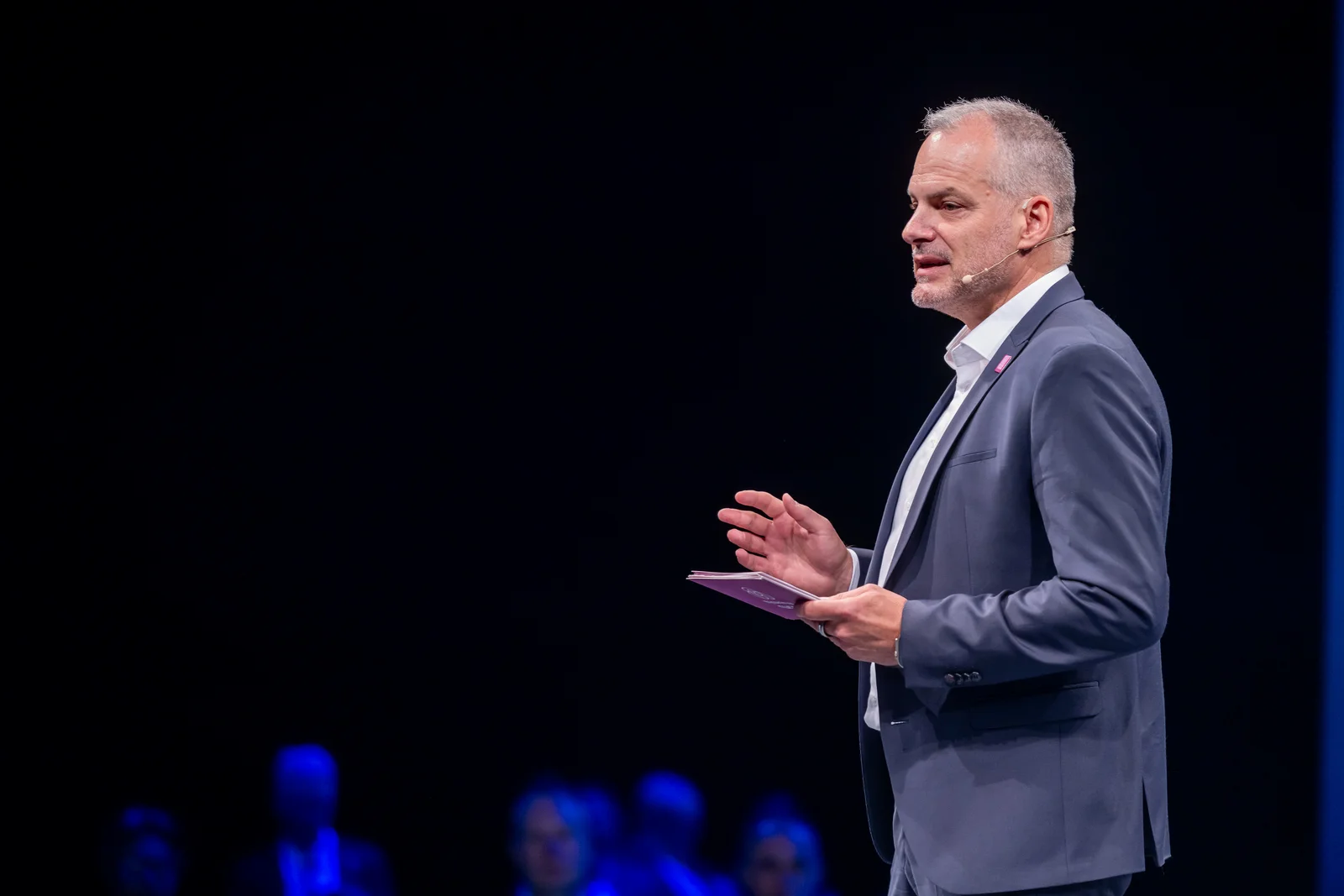
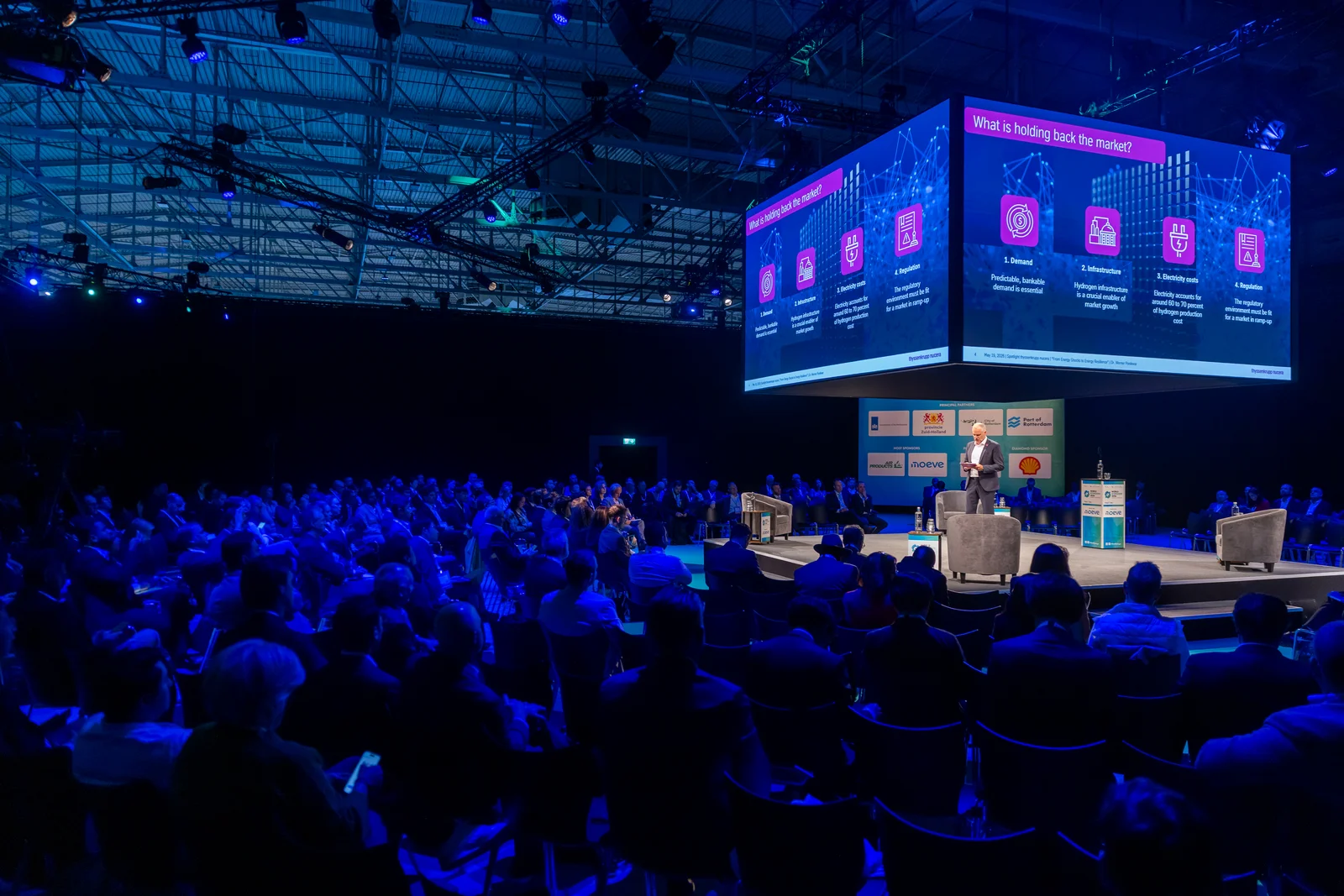
Werner Ponikwar's keynote at World Hydrogen Summit Rotterdam
Europe Needs Industrial Capabilities Instead of Short-Term Fixes
Let me be clear: if Europe wants a resilient industrial energy system, we need industrial capabilities – not short‑term fixes. Electrolysis links renewable power to industrial value creation by converting electricity into molecules. This is essential for a resilient industrial energy system and Europe still leads in high‑value electrolysis IP. European OEMs have developed competitive technologies over decades and the capability to scale them. Europe’s electrolysis industry is globally competitive, in particular when it comes to levelized cost of hydrogen. I stress this because even where the levelized cost of hydrogen (LCOH) is superior already, procurement still prioritizes lower upfront cost. That is a rather short-sighted perspective and risks accelerating market-share losses for European manufacturers at a critical stage of industry scale-up. In fact, European electrolyzers can beat Chinese peers on LCOH, due to superior efficiency and in particular due to better lifecycle performance. A cost factor highly underestimated by an industry with limited long-term experience in operating such plants. But if the logic is so clear – why are we not seeing more projects reaching Final Investment Decision (FID)? We have the technology and a strong pipeline, yet fewer than one in ten projects has reached FID.
The Four Bottlenecks
The bottlenecks are clear: bankable demand, enabling infrastructure, competitive electricity, and regulation that is fit for scale‑up. Let's take one by one:
1. Bankable Demand
Electrolysis projects are capital‑intensive. Scaling them is a financing challenge – and scale is what makes projects competitive. So, predictable, bankable demand is essential. We are seeing promising developments – for example, the RFNBO quota in Germany’s transport sector – but uncertainty around application and enforcement still weighs on investment decisions.
2. Enabling Infrastructure
Hydrogen infrastructure is a crucial enabler of market growth. It connects supply and demand centers. Businesses need certainty on when, where – and ideally at what cost – clean hydrogen is accessible for them across the EU. The scale-up of other industries, like for example in LNG clearly showed: without grid build‑out, progress will stall.
3. Competitive Electricity
Electricity accounts for around 60 to 70 percent of hydrogen production cost. If electricity costs are high, so is the levelized cost of hydrogen. As an electrolyzer OEM, we can build the most efficient machines and drive down total cost of ownership. But where the key feedstock for clean hydrogen production stays expensive, hydrogen costs will hardly become competitive – no matter how good and cost efficient the technology is. Thus, we need affordable electricity costs of 5-euro cents per kilowatt-hour or less in the EU to make clean hydrogen an industrially relevant energy carrier.
4. Regulation Fit for Scale-Up
The regulatory environment must be fit for a market in ramp‑up. Excessive complexity adds cost at the very phase where scale is still being built. Imagine applying similarly strict - and barely workable RFNBO - rules to early electric mobility – there would hardly be any electric vehicles on European roads today. More pragmatic RFNBO requirements could reduce clean hydrogen costs immediately by around 2 euros per kilogram. Here, upcoming regulatory reviews offer an opportunity to better align requirements with the realities of market scale‑up.
Taken together, these four bottlenecks explain why scale‑up remains slow. Remove them – through bankable demand, infrastructure, affordable electricity and a regulatory framework fit for scale‑up – and clean hydrogen costs below 4 euros per kilogram are achievable in Europe.
What Needs to Change to Make This Hydrogen Market Work?
This market will not build itself. Electrolysis is a capital‑intensive, long‑term investment – hydrogen markets are built. Market build‑up starts with demand. Clear demand anchors, such as RED III and lead markets, are essential to turn projects into bankable investments. Infrastructure enables scale. Electrolysis, clean‑hydrogen demand and infrastructure must be built in parallel – pipelines, storage and cross‑border coordination are prerequisites, not optional add‑ons. In the current scale‑up phase, clear Made‑in‑EU criteria under the Industrial Accelerator Act are essential to strengthen resilience – and will support competitiveness and long‑term industrial capability when public funds are used. My main takeaway is simple: get the fundamentals right so that the market can scale with fewer financial support.
WHS Rotterdam / Maarten Schuth
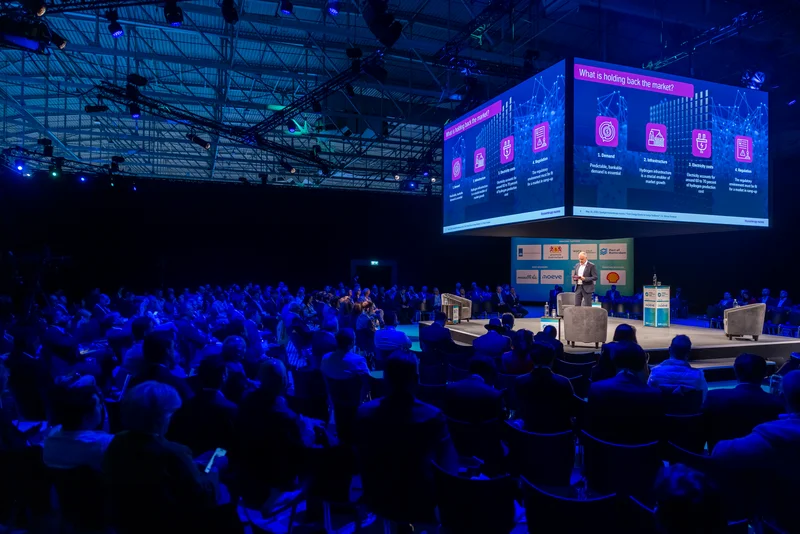
Werner Ponikwar on stage at World Hydrogen Summit Rotterdam 2026
What Happens If We Do Not Act?
The consequences are clear:
For our industry as a whole: value creation moves elsewhere. Projects, capital and investment follow markets that offer clarity, demand and scale.
For us, electrolyzer OEMs: we lose ground in global competition. Without a strong home market, scale effects and learning curves disappear – and with them, technological leadership.
And for society overall: dependencies persist, and resilience stays a buzzword.
The cost of inaction is not zero. It is paid in
lost value creation,
lost competitiveness,
and long‑term dependency.
Let me add one more observation from the industrial side. In early March, Moeve took Final Investment Decision for the first phase of the Andalusian Green Hydrogen Valley – the 300‑megawatt Onuba project – supplied with our electrolysis technology. Globally, it is one of the very few large‑scale hydrogen projects to reach FID in recent months. First, it shows that projects can move from ambition to investment, where specific barriers are overcome. Second, it shows why this still stands out – because such examples are not yet the norm. In Europe, this momentum remains highly concentrated. So far this year, around 500 MW of electrolysis capacity have reached Final Investment Decision, with the Onuba project accounting for a significant share.
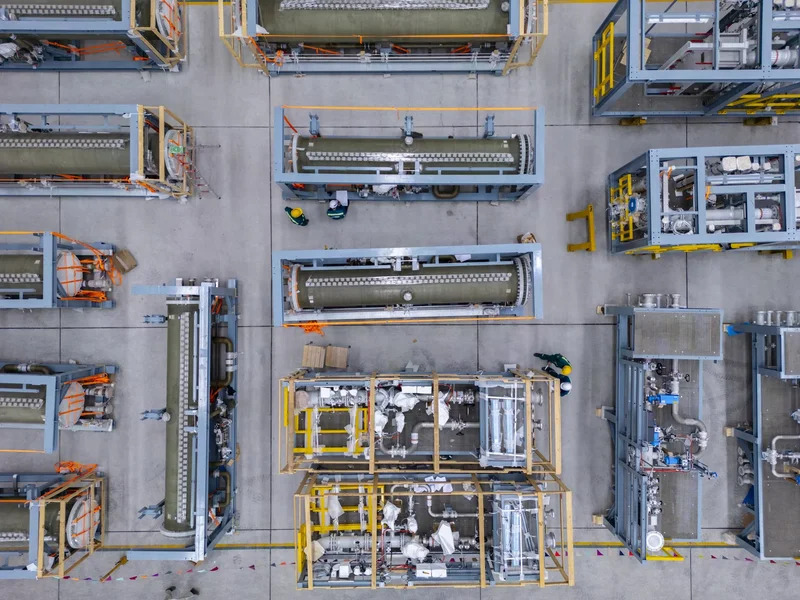
From our perspective as an electrolyzer manufacturer, the implication is clear. The question is no longer whether electrolysis works, but under which conditions projects become investable. At thyssenkrupp nucera, we focus on exactly that point. We deliver industrial electrolysis at scale as a long-term partner with more than 3.5 gigawatts of green hydrogen capacity under execution, and a clear focus on reliability and performance over decades, not just at commissioning. So, the takeaway is simple: Industrial‑scale hydrogen projects can be delivered. Onuba is a recent example of what becomes possible once projects are investable – and why we now need to make those outcomes repeatable.
Where Does This Leave Us?
Europe has the technology, the industrial capability and a strong project pipeline. What is missing to trigger large-scale execution is trust: in an integrated market and in infrastructure build-out. Europe needs to build resilience. And for that, it should rely as much as it can on technology made-in-EU. There is no point in replacing one dependency with another. In the current scale-up phase, applying made-in-EU criteria to projects supported by public money is a prerequisite for resilience, competitiveness and long‑term industrial strength. The choice is clear. We can keep reacting to energy shocks and let another strategic technology slip away – or we can build resilience deliberately through investment, infrastructure and execution.
Author
CEO, thyssenkrupp nucera